Many trees in Massachusetts landscapes struggle silently for years before homeowners notice a problem. Thinning leaves, slow growth, early fall color, or stressed-looking canopies are often linked to what’s happening underground.
In many cases, the issue is poor soil health.
Deep root fertilization helps improve soil conditions around trees by delivering nutrients directly into the root zone where they can actually be absorbed. For stressed landscape trees, this treatment can support stronger growth, improved resilience, and recovery from environmental stress.
What Is Deep Root Fertilization?
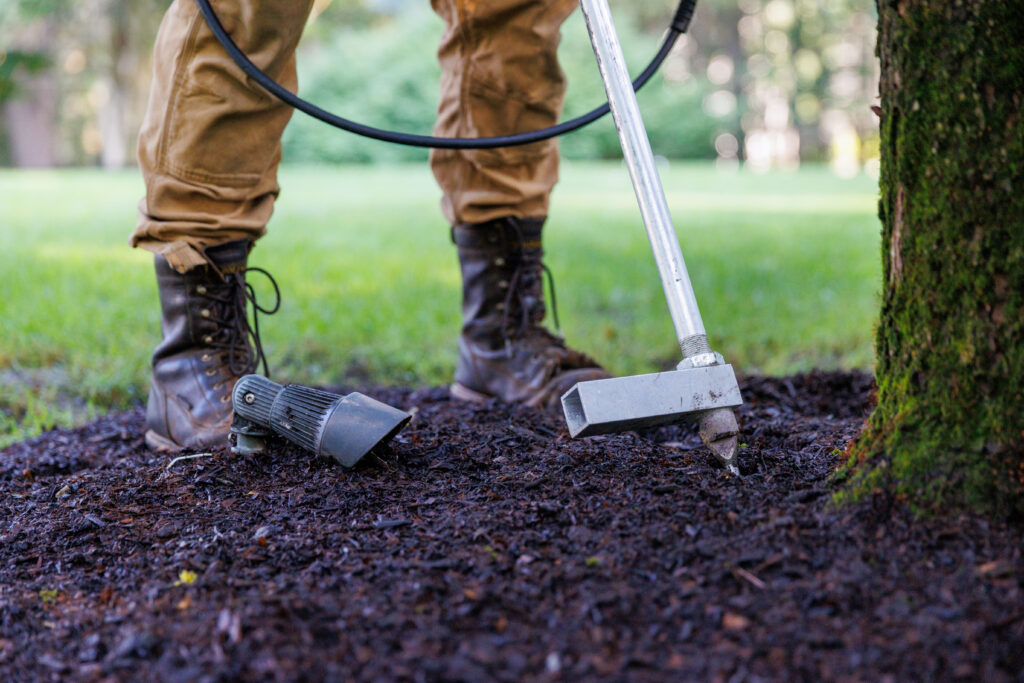
Deep root fertilization is a soil treatment that injects liquid nutrients directly into the ground around a tree’s root system.
Unlike surface fertilizing, which can sit on top of compacted soil or get absorbed by turfgrass, deep root fertilization places nutrients deeper into the soil profile where tree roots are actively growing.
The process also helps:
- Improve oxygen movement in compacted soil
- Encourage healthier root development
- Support microbial activity in the soil
- Reduce stress caused by poor growing conditions
At Marquis Tree Service, deep root fertilization is commonly recommended for mature landscape trees showing signs of stress or decline.
Why Massachusetts Trees Often Lack Nutrients
Trees growing in forests naturally recycle nutrients through decomposing leaves and organic material. Landscape trees do not have the same environment.
In Massachusetts suburbs and urban areas, trees often face:
- Soil compaction from foot traffic and equipment
- Construction-related root damage
- Competition with lawns for nutrients and water
- Shallow or poor-quality soil
- Heat and drought stress during summer
- Salt exposure near roads and driveways
These conditions make it harder for roots to access oxygen, water, and nutrients—even when trees appear healthy from a distance.
Compacted soil is especially common around mature shade trees in towns like Lexington, Concord, Arlington, and Newton where older landscapes have experienced years of traffic and development.
Signs Your Tree May Benefit From Deep Root Fertilization
Not every tree requires fertilization, but several symptoms can indicate poor soil health or nutrient stress.
Watch for:
- Yellowing or pale leaves
- Thinning canopy growth
- Small or undersized leaves
- Reduced annual growth
- Early fall color change
- Stress after nearby construction work
- Decline during hot or dry weather
These symptoms do not always mean a tree is dying. In many cases, they indicate the root system is struggling to function efficiently.
An arborist can determine whether deep root fertilization is appropriate or if another issue is contributing to the decline.
Is June Too Late for Deep Root Fertilization?
No. Spring through early summer is still an effective time for deep root fertilization in Massachusetts.
By June, trees are actively growing and beginning to respond to warmer temperatures and increasing moisture demands. Fertilization during this period can help support root activity ahead of summer heat and drought stress.
This timing is especially helpful for:
- Trees recovering from winter damage
- Trees stressed by spring construction activity
- Newly planted trees establishing roots
- Mature trees entering dry summer conditions
Deep root fertilization can also be beneficial in fall depending on tree species and site conditions.
How Deep Root Fertilization Supports Tree Health
Healthy roots are the foundation of a healthy tree.
When soil conditions improve, trees are often better able to:
- Absorb water efficiently
- Produce fuller canopy growth
- Tolerate drought stress
- Recover from environmental damage
- Resist certain pests and diseases
- Maintain stronger overall vigor
For mature trees, maintaining root health is especially important because recovery from stress tends to happen more slowly over time.
Deep root fertilization is commonly used as part of a larger plant health care strategy focused on long-term tree preservation.
Why Fertilization Is Often Combined With Bio-Hydration
During dry Massachusetts summers, trees often experience both nutrient stress and moisture stress at the same time.
In some situations, deep root fertilization is paired with bio-hydration treatments to help:
- Improve soil moisture retention
- Reduce drought stress
- Decompact soil
- Support root recovery
This combination can be especially beneficial for trees affected by recent drought conditions or compacted urban soils.
According to Marquis Tree Service treatment guidelines, bio-hydration is often recommended alongside fertilization programs for stressed trees recovering from drought and soil compaction.
When Deep Root Fertilization Will Not Help
Fertilization is not a cure-all.
Trees with severe structural defects, advanced decline, extensive root damage, or major decay problems may not respond to treatment. In some cases, removal may be the safer and more practical option.
That is why professional diagnosis matters.
At Marquis Tree Service, recommendations are based on tree condition, site factors, and long-term health potential—not simply applying treatments that are unlikely to provide meaningful results.
Professional Tree Health Care in Massachusetts
Deep root fertilization can be an effective way to support stressed landscape trees when applied at the right time and for the right reasons.
If your trees are showing signs of thinning, yellowing, slow growth, or stress after construction or drought conditions, a professional evaluation can help determine the best course of action.
Marquis Tree Service provides plant health care, deep root fertilization, pruning, and arborist consultations throughout the Greater Boston area.
Ready for a free estimate? Call us today at 781-860-9618 or contact us online.